
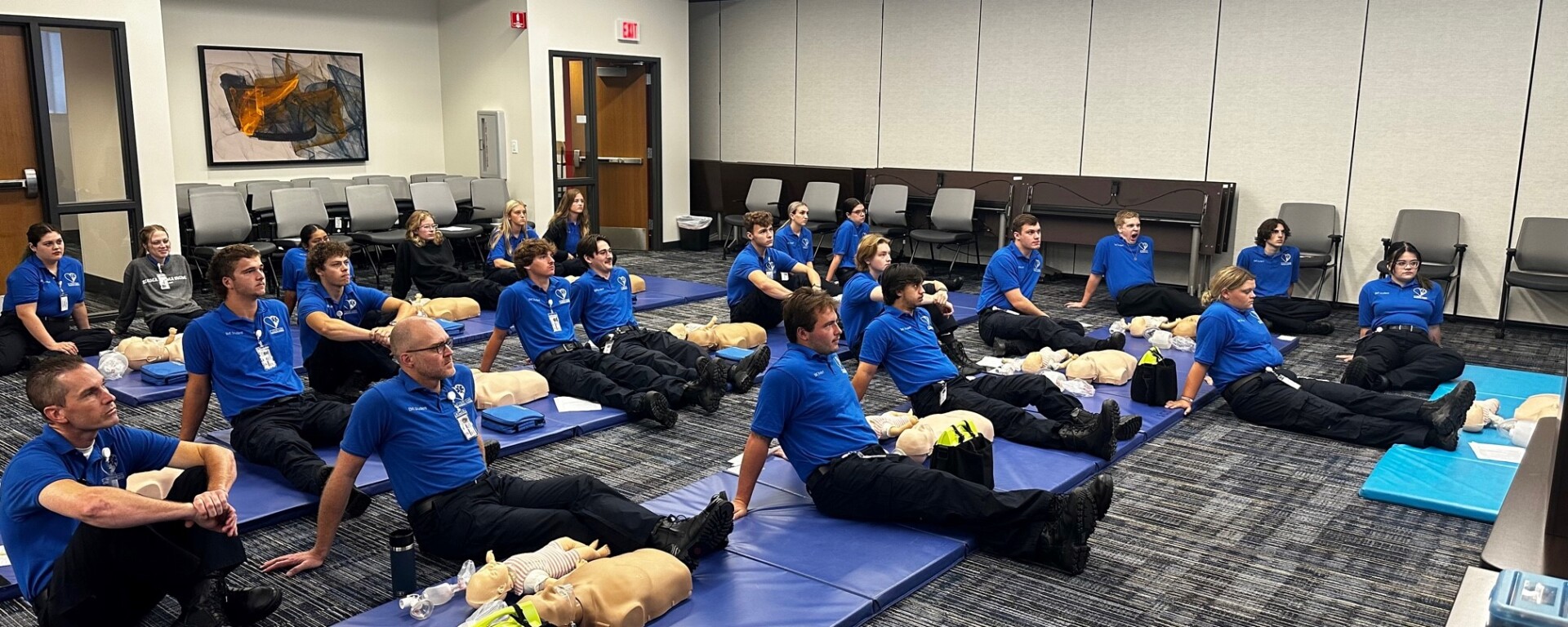
Applications for the Spring 2027 EMT Program are now being accepted. Please review the course brochure below; applications must be submitted by October 30.
Spring 2027 EMT Brochure (PDF)
Overview
SCCAD’s EMS Academy offers two EMT classes this year beginning in January and August. The January and August classes meet on Wednesday from 8 a.m. to 5 p.m. and run for approximately five months. Some virtual and some Saturday classes may also be required.
Prerequisites
- Medical Terminology 3 credit hours (HIM 110) at St. Charles Community College or equivalent course approved by the program director
- Missouri Family Care Safety Registration
- Current TB test (within last 12 months)
- Hepatitis B and MMR vaccination
- Tetanus/diphtheria Acellular-Pertussis (DTaP) vaccination
- COVID-19 vaccine is NOT required, but preferred (submit a copy of card)
- Note: some clinical sites require COVID-19 vaccination. Exemptions may be granted. Students are responsible for requesting exemptions from each clinical site and must provide SCCAD with exemption documentation. Contact Ms. Price at [email protected] for more information.
- Varicella vaccination or positive titers
- Current season’s influenza vaccination
- Copy of current health insurance card (requirement for some clinical sites)
- EMT Entrance Assessment – $5 non-refundable fee
- Proof of 18 years of age or older (copy of driver’s license)
- Official high school transcript
- ALL college official transcripts (submit with application)
- One letter of recommendation from an instructor, an employer, or supervisor (submit with application)
- Submit a course application by program deadline
*NOTE: AHA Basic Life Support (BLS) CPR will be taught as part of the course curriculum during the first week of class.
Clinical Content
EMT skills include evaluating the severity of a patient’s injury or illness, establishing an airway, bleeding control, bandaging wounds, splinting broken bones, electrical defibrillation, pre-hospital childbirth, vehicle rescue and ambulance operations. In addition to the classroom, students are required to spend a total of 28-32 hours in a clinical setting observing in hospital and ambulance settings. Currently, the field clinical site is SCCAD and hospital clinicals are completed at an Emergency Department within St. Charles County.
Program Completion
Successful completion of this course will prepare the student for the National Registry of EMTs exam. Missouri requires the student to successfully complete a stat-approved practical exam and the NREMT written exam to be eligible for licensure.
Additional Information
To learn more about the EMT Program or schedule an appointment to discuss EMT Training, contact our Training Division Coordinator at 636.344.7641 or the program director at [email protected]. If you provide us with your contact information, we will update you with relevant information about our program.

Course Fee
Tuition: $1,748.00
Book Fee: $225
ANSI II Vest: $28 (refundable upon return of vest)
Students responsible for providing their own stethoscope and Wi-Fi capable tablet or laptop.
*Prices subject to change. Eligible applicants may qualify for tuition assistance under the GI Bill®. This program is not a regionally accredited college or university. Students are not eligible for federal financial aid, and this program cannot issue a 1098-T for tax reporting purposes.
EMT Selection Process & Course Admission
The selection process for admission is a competitive two-part process including evaluation of the application and a formal panel interview. Selection criteria includes, but is not limited to, evaluation of the application, prior education, volunteer experience, community service, and a formal panel interview. Applications with cumulative high school and college GPAs greater than 2.5 will be preferred over other applications. Once applications are evaluated, invitations for formal interview dates and times will be emailed.
Technical Standards
To perform adequately and safely in the classroom, hospital, and pre-hospital clinical areas, the student must meet the following functional capabilities:
Motor
- Must be able to stand, walk, squat, crawl, kneel, bend/stoop, reach above shoulder level, use standing balance, and climb stairs.
- Reach with hands and arms above the shoulders and over 18 inches, reaching below the shoulders and to the floor. Lift/carry up to 50 lbs. Exert up to 37.5 lbs. force to push or 33.5 lbs. to pull.
- Use hands repetitively with manual dexterity sufficient to finger, handle and feel; fine motor function to manipulate needles and start IVs.
- Must be able to walk and stand for prolonged periods of time.
- Perform CPR according to current AHA guidelines
- Travel to and from class and clinical sites in a timely manner.
Sensory
- Must hear verbal communication face-to-face and by telephone or radio.
- Must have sufficient aural keenness to evaluate blood pressure, and breath or heart sounds.
- Visual abilities to include: close vision distance vision, color vision, peripheral vision, depth perception and ability to adjust focus. Must be able to read information from a computer screen, documents or charts; interpret colorimetric diagnostic indicators and visual warning devices; read warning placards and perform scene size-up from a distance; perform visual examination of patient.
Communication
- Communicates fluently in English verbally and in writing.
- Retrieves information from lectures, textbooks, and computer aids.
- Adapts communication for intended audience.
- Interacts with people from a variety of social, cultural, emotional and intellectual backgrounds.
- Functions effectively under supervision.
- Computer skills to include: accessing the internet, using a word processing program and receiving and sending email
Problem-Solving
- Functions effectively in a stressful situation.
- Responds appropriately to emergency situations.
- Can reason, measure, calculate, prioritize and synthesize data to problem-solve while performing patient care activities.
- Uses sound judgment and safety precautions.
- Organizes and prioritizes job tasks.
GI Bill® Payment
Students eligible for program payment through the GI Bill® must provide the school with a certificate of eligibility or valid VAF 28-1905 in lieu of the initial payment. The student may attend class for up to 90 days while payment from the Veteran’s administration is pending. No penalties or late fees will be assessed to eligible students for late payment from the VA.
GI Bill® is a registered trademark of the U.S. Department of Veterans Affairs (VA). More information about education benefits offered by VA is available at the official U.S. government Web site at https://www.benefits.va.gov/gibill.
Refunds to veterans or eligible persons who fail to enter or fail to complete the course will comply with the Department of Veterans Affair Regulations, CFR 21.4255.